
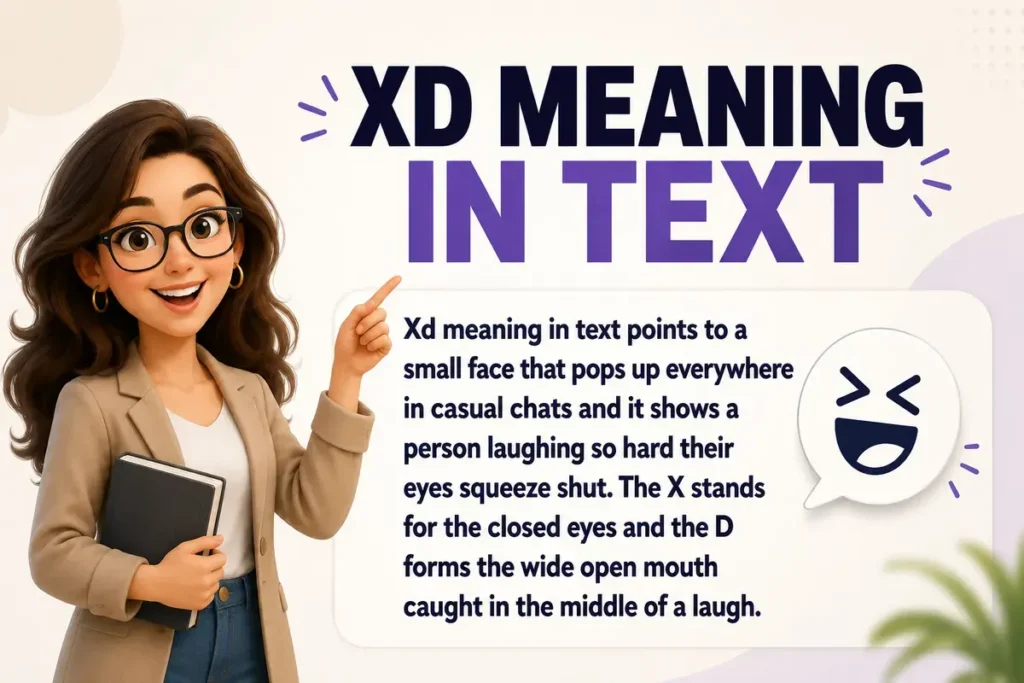
Xd meaning in text points to a small face that pops up everywhere in casual chats and it shows a person laughing so hard their eyes squeeze shut. The X stands for the closed eyes and the D forms the wide open mouth caught in the middle of a laugh. People drop it into a message the second something strikes them as genuinely funny. It works as a quick stand in for actual laughter when typing out words feels too slow. It carries warmth and humor rather than sarcasm, which sets it apart from a flat lol. Most people who use it are not thinking about grammar or formality, they just want to show real amusement in the fastest way possible. It has stayed a steady part of casual texting for years now, even as new emoji and reaction stickers keep getting added to messaging apps.
Related article: hmmm meaning in text What It Really Means in Chat.
Xd Meaning in Text at a Glance
| Aspect | Details |
|---|---|
| Part of speech | Interjection or emoticon |
| Definition | A text symbol showing strong laughter or amusement |
| Language of origin | English internet slang with roots in early gaming culture |
| Context of use | Texting, social media comments, gaming chat, casual conversation |
| Pronunciation | Said as the two letters “ex dee” or simply read silently as a laugh symbol |
What Does It Mean
At its core, xd meaning in text comes down to one simple idea, someone finds something hilarious and wants to show it instantly. Picture the letters sideways. The X becomes two eyes shut tight from laughing and the D becomes a mouth stretched open in pure joy. There is no deep mystery behind it once you flip your head and look at it the right way.
It also works as a softener. A blunt comment followed by xd suddenly feels playful instead of harsh. Friends use it to take the edge off teasing or to signal that a joke should not be taken too seriously. This small shift in tone is part of why the symbol spread so widely across so many different platforms and age groups.
Another reason it sticks around is how little effort it takes to type. Two letters sitting next to each other on most keyboards can carry the same emotional punch as a full sentence describing how funny something felt. That kind of efficiency matters a lot in fast moving group chats where messages pile up quickly and nobody wants to scroll through a wall of text just to understand a simple reaction. The symbol gives a clear emotional cue in less time than it takes to type even a short word like funny.
People also lean on it when a typed joke needs proof that it actually landed. Sarcasm and dry humor do not always translate well through plain text, so adding this little laughing face removes any doubt about how a message should be read. It tells the other person clearly that the line above was meant to be funny rather than serious or rude.
Deeper Meaning and Significance
Every piece of internet shorthand carries more than one layer once you look past the surface. This symbol is no different and it holds both a literal layer and a layer tied to feeling and connection.
Primary Meaning
On the surface level, xd is a direct stand in for laughing hard. Someone reads a funny comment, a meme or a joke from a friend and types it back as an instant reaction. The literal meaning rarely changes from person to person or platform to platform. It almost always points to genuine amusement rather than confusion or sadness. This makes it one of the more reliable pieces of internet shorthand since its core meaning has stayed steady for years.
Secondary Meaning
Beyond the literal laugh, the symbol often signals comfort and closeness between the people texting. Dropping it into a chat tells the other person that the mood is light and friendly. It can soften criticism, ease tension after an awkward moment or show that someone feels relaxed enough to be silly. Among close friends it sometimes becomes a small inside joke of its own, used so often that its presence feels like a personal touch rather than a generic reaction. In that sense, it carries a quiet emotional signal of trust and familiarity that goes beyond the plain idea of laughter.
This deeper layer also explains why the symbol feels different coming from a stranger compared to a close friend. Between people who already know each other well, it often works almost like a small wink, a way of saying the conversation feels easy and natural. Between strangers or new acquaintances, the same symbol still works as a friendly signal, showing that the sender wants the exchange to stay relaxed rather than tense or overly formal.
Origin and Etymology
The roots of this expression trace back to early internet gaming communities, where players needed a fast way to react to funny moments without breaking focus on the game. Typing out long reactions during a match was never practical, so short symbols built from regular keyboard letters became the norm. The sideways face made from X and D fit perfectly into that fast paced typing style.
From gaming forums and chat rooms, the symbol slowly spread into broader internet culture during the rise of instant messaging platforms in the early 2000s. As texting on phones became common, people carried the habit over from their keyboards to their thumbs. Younger users picked it up quickly since it matched the playful tone already common in early internet slang. Over time, xd meaning in text settled into something almost anyone online recognizes on sight, even people who do not use it themselves.
Its staying power likely comes from how simple it is to type and how clearly it reads once a person learns to tilt their head and see the face hidden in the letters. Unlike some slang that fades after a year or two, this one has lasted because it fills a need that never really goes away, the need to show real laughter fast.
Many other emoticons from that same early internet period have faded out of common use, replaced by colorful emoji that do the same job with a single tap. This particular symbol managed to survive that shift, partly because it still feels personal in a way that a standard emoji sometimes does not. Typing it out by hand carries a slightly different weight than tapping a premade picture, even if the end result communicates almost the same feeling.
Examples in Sentences
Seeing the symbol used in real conversation makes its meaning click much faster than any definition alone. The examples below cover a few common situations where it naturally fits into the flow of a casual message.
Real Life Examples
- She sent a photo of her cat stuck in a box and added xd right after.
- My brother tripped over his own shoes in front of everyone and I could not stop laughing, xd.
- He replied to my terrible joke with just one word, xd, and nothing else.
- The whole group chat turned into a string of xd messages after someone shared the wrong screenshot by accident.
Everyday Usage
Friends use this symbol constantly in group chats when sharing memes or screenshots that strike them as funny. Gamers type it mid match after a wild or unexpected moment changes the outcome of a round. Coworkers sometimes slip it into casual internal messages when a meeting joke needs a quick reaction. Even parents and older relatives have started picking it up after seeing it enough times from younger family members. Its casual nature makes it fit almost any relaxed conversation where a laugh needs to travel through text instead of sound.
Online creators and influencers use it often in comment replies to fans, since it keeps interactions feeling personal and friendly rather than scripted. Customer support teams on social media occasionally borrow it too, though only in brands that already lean toward a relaxed and youthful voice. Even in classroom group projects, students sometimes drop it into shared chats to lighten the mood after a stressful deadline.
Synonyms and Related Terms
People often swap this symbol with a handful of similar expressions depending on mood and platform.
- Lol, used for a general laugh without much intensity.
- Lmao, used when something feels noticeably funnier.
- Haha or hahaha, a more written out version of laughter.
- Rofl, an older term for rolling on the floor laughing.
- The crying laughing emoji, a visual alternative that carries a similar tone.
Each of these carries a slightly different weight, but all of them share the same basic goal, showing genuine amusement through text. Choosing between them often comes down to personal habit more than any strict rule. Some people stick to one favorite their whole life, while others switch between several depending on who they are talking to and how strong the laugh actually felt in the moment.
Meaning in Different Contexts
The exact tone behind this symbol can shift depending on who sends it and where the conversation happens. Xd meaning in text from a girl often leans toward warmth and easy comfort, especially in a chat with someone she already trusts. It usually signals that she finds the conversation genuinely entertaining rather than forced or polite.
Xd meaning in text from a guy can carry a slightly different flavor depending on the relationship. Among friends, it almost always points to plain amusement. In a flirty exchange, an XD meaning from a guy flirty often works as a way to keep things light while still showing real interest, since laughter naturally lowers the guard between two people getting to know each other.
On Instagram, XD meaning often shows up in comment sections under funny posts, reels or stories, working as a quick reaction that fits the platform’s fast scroll culture. In gaming spaces, XD meaning in game chats almost always reacts to a surprising kill, a funny glitch or an unexpected team moment, since players rarely have time to type long reactions mid match.
What does XD mean in Roblox follows that same gaming logic, with younger players using it constantly inside chat boxes to react to funny in game moments or silly mistakes from other players. The symbol also travels well across languages. Xd meaning in text Spanish stays close to the original English use, since Spanish speaking teens and young adults adopted it directly from global internet culture without changing its core laughing meaning. Similarly, XD meaning in chat Tagalog keeps the same laughing tone, often appearing in casual Filipino online conversations exactly the way it appears in English chats, since internet slang tends to cross language barriers with very little change in meaning.
Cultural or Symbolic Significance
Beyond its simple definition, this small symbol says something about how digital communication has evolved. Before emojis became common on every device, people needed creative ways to show emotion using nothing but a standard keyboard. Symbols like this one filled that gap and became a kind of shared visual language understood across borders and age groups.
It also reflects how humor travels differently online compared to face to face conversation. A real laugh has tone, volume and timing, none of which text can capture directly. This symbol acts as a stand in for all of that missing context, letting people show genuine reaction without needing a video call or voice note. Its widespread use across platforms, languages and age groups shows just how universal the need for quick, visual laughter has become in modern communication.
In a small way, this tiny piece of internet shorthand also marks generational identity. Many older internet users remember it fondly from the early days of instant messaging, while younger users encounter it through gaming chats or social media comments without ever knowing its history. That shared symbol, passed down across different waves of internet culture, helps connect very different generations through one common piece of digital language.
Related article: IMY Meaning in Text Explained: The Definition You Need to Know
Conclusion
At the end of the day, xd meaning in text comes down to something refreshingly simple, a fast and visual way to show laughter when words alone cannot keep up. It started in gaming circles, spread through early messaging culture and settled into everyday texting habits across the world. It might show up in a flirty exchange, a gaming match or a casual comment between friends, but its core message rarely changes.
What makes this little symbol so lasting is how naturally it fits into modern conversation. It needs no explanation once someone learns to read the sideways face hidden in two simple letters. Understanding xd meaning in text gives you one more small but useful piece of the larger puzzle that makes up casual digital language today. The next time it shows up in your messages, you will know exactly what kind of laugh is hiding behind those two letters.
FAQs
Not exactly. LOL covers a wide range of amusement, from mild to strong. XD usually points to a more intense reaction, closer to genuine laughter than a polite acknowledgment of a joke.
Yes, plenty of older users have picked it up after seeing it often enough in family group chats or social media comments.
Rarely. It almost always signals amusement or warmth rather than sarcasm or anger, which makes it one of the safer reactions to use in casual conversation.
Some people find it faster to type using only letters already on the keyboard, while others simply grew up using it before laughing emojis became as common as they are now.
Yes, it shows up frequently in Spanish, Filipino and many other online communities, since internet slang tends to spread quickly across language barriers.
It works best in casual settings like texting, gaming or social media. Most workplaces still expect more formal language in official emails or reports.
Not really. Capital letters or lowercase letters carry the same meaning either way. Capital letters sometimes just add a bit more visual emphasis to the reaction.
Quick typing speed mattered a lot in fast paced online games, so short reactions built from regular keys made more sense than longer phrases during an active match.

Ava Reynolds researches name meanings, word origins, and cultural interpretations. She enjoys breaking down complex topics into clear, easy-to-understand explanations that help readers quickly find the answers they’re looking for.